Is the Banksy Museum worth visiting?
Inside, the city noise drops away and you move through brick-lined rooms where familiar images — a girl reaching for a balloon, a protester throwing flowers — appear at mural scale. It feels less like a traditional museum and more like walking through a compressed streetscape built out of satire, anger, and visual wit.
The museum was built to gather Banksy works that are scattered, erased, or impossible to see in one trip, and to place them in enough context that first-time visitors can follow the jokes, the politics, and the provocation behind them.
The payoff is concentration: in about an hour, you can trace how one anonymous artist turned stencils into a global language of protest. It’s especially strong for first-time art visitors, families with older kids, and anyone curious about street art without committing to a half-day museum.
Skip it if you only want original artworks or you’re looking for a quiet, classical museum visit.
What to see at the Banksy Museum?
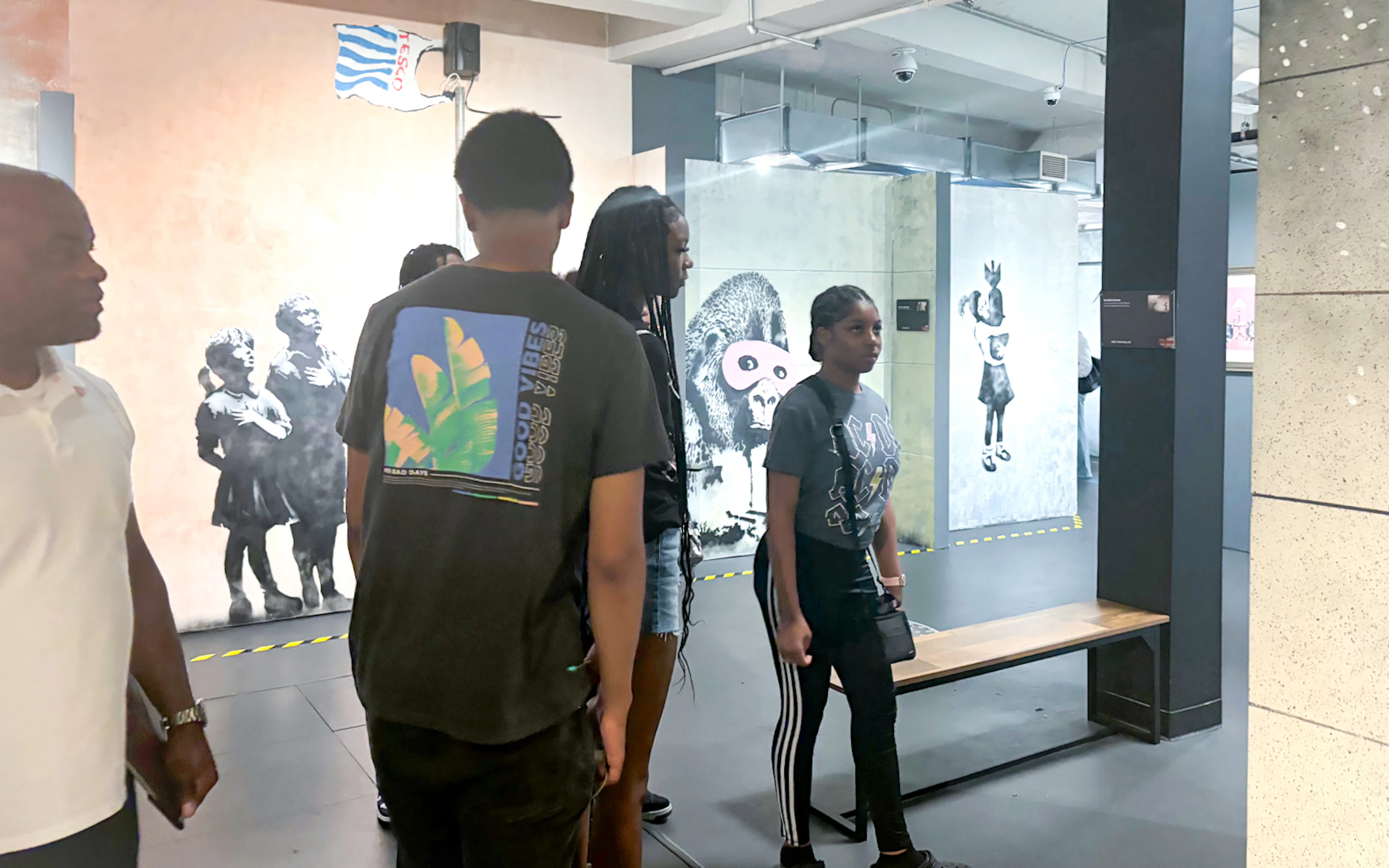
Signature murals gallery
This is where the best-known Banksy images hit first, scaled to the size they were meant to have on a wall rather than on a screen. Give yourself a few extra minutes here; most visitors naturally slow down.
Girl with Balloon
One of Banksy’s most recognizable images, recreated at full scale so its simplicity lands properly. Seen in person, it reads less like a meme and more like a sharp piece about loss, hope, and disappearance.
Flower Thrower
Banksy’s masked protester throwing a bouquet remains one of the clearest statements in the museum. The work is small in concept but huge in effect, and it helps anchor the museum’s broader anti-violence, anti-authoritarian tone.
Anti-war and protest works
Several rooms focus on Banksy’s political side, including works tied to conflict, policing, and power. Don’t rush these; they need more reading time than the brighter photo-friendly murals near the entrance.
Recreated street environments
Some of the strongest spaces are entire urban scenes — rough walls, alley-like passages, taped-off corners, and ambient effects — built to restore the feeling of finding Banksy unexpectedly in the city.
Crisis and disaster pieces
Look for works connected to places such as New Orleans and Ukraine, where Banksy’s imagery responds directly to damage, fear, and resilience. These pieces give the museum more emotional range than a simple greatest-hits format.
Multimedia and rare-format displays
Beyond the wall recreations, the museum uses video, projection, and context panels to widen the story. These sections matter most if you want to understand how Banksy’s public image became as powerful as the works themselves.
Screening space
If a Banksy-related film is running during your visit, it’s worth ending here. Screenings take longer than the rest of the galleries, and seats can fill quickly when visitors time their entry around show slots.
How much time to spend?
Budget 60–90 minutes for the full museum. If you move quickly and mainly want the best-known murals, 45 minutes is enough. Add extra time if you want to catch a film screening or you like stopping to read the political context around each work.
Best visit order
Start with the signature recreations on the second floor, then move steadily through the themed rooms before heading upstairs to the larger immersive environments. Save the screening space for the end if a film is about to start; it works better once you’ve already seen the visual references in the galleries.
Must-see highlights
Must-see: Girl with Balloon, Flower Thrower, the anti-war rooms, and the recreated street scenes that make the visit feel closer to an alleyway than a white-walled museum. Optional: the screening room and any special programming, which can add 30–60 minutes.
Worth adding nearby
SoHo, Chinatown, and Little Italy are right outside, so this visit pairs easily with a neighborhood walk or meal. If you want another museum the same day, the 9/11 Memorial & Museum or MoMA each turn the outing into a broader art-or-history plan.
Guided or self-paced?
Self-paced works well here because the visit is compact and the visual ideas land quickly when you can linger where you want. If you’re comparing Banksy Museum tickets NYC travelers usually book, the standard The Banksy Museum Ticket is enough for most visits. For a longer art day, the better upgrade is Combo (Save 10%): Museum of Modern Art (MoMA) Tickets + The Banksy Museum Ticket; for Lower Manhattan, choose Combo (Save 10%): 9/11 Memorial & Museum Tickets + The Banksy Museum Ticket.
Brief history of the Banksy Museum
- 2000s–2010s: Banksy becomes the defining anonymous voice of contemporary street art, with site-specific works appearing across the United Kingdom, Europe, the Middle East, and the United States.
- Paris and Barcelona runs: The Museum of Banksy concept develops as a traveling format, recreating works that are scattered, damaged, or inaccessible in their original street settings.
- May 2024: The Banksy Museum opens on Canal Street in New York as the American premiere of the concept.
- Opening season: More than 160 life-size recreations, installations, and multimedia displays are assembled across about 15,000 square feet.
- Today: The museum functions as a concentrated introduction to Banksy’s imagery and politics, bringing together works visitors would otherwise need several countries to piece together.
Architecture of the Banksy Museum
This isn’t architecture in the monumental sense; it’s exhibition design built to change how you read street art. Inside the Banksy Museum, clean gallery logic gives way to brick textures, dim corners, warning tape, rough walls, and room-scale recreations that mimic the urban surfaces Banksy originally worked on. The effect matters: instead of viewing isolated images, you encounter them at the scale and eye-line they were meant to have in public space. The design also uses sound, video, and tighter transitions between rooms to keep the visit feeling like a city walk rather than a march through labeled frames. Notice how often the surfaces look temporary, tagged, or slightly raw. That deliberately unfinished quality stops the museum from feeling too polished for the art it houses.
Who built it?
The New York museum opened in 2024 as the American edition of the traveling Museum of Banksy concept. A star architect isn’t the story here; the key work came from exhibition designers and fabricators who translated scattered street sites into one indoor route built to preserve context, scale, and atmosphere.
Why a Banksy museum is inherently controversial
Banksy built his reputation by placing art in public space, often without permission, and letting the street do half the work. That means any museum devoted to him carries a tension at its core: the institution preserves images that were originally anti-institutional. At the Banksy Museum, that tension is part of the experience rather than a flaw. You’re seeing what happens when temporary, risky, place-specific work is reconstructed indoors so it can be studied, photographed, and debated long after the original wall, door, or barrier has changed or disappeared.
Frequently asked questions about the Banksy Museum
No. The museum is built around full-scale recreations, installations, and contextual displays rather than original street pieces. That’s the trade-off: you lose the original surface, but you gain the rare chance to see works from different countries in one visit.
No, the current Headout standard product lists entry to the museum only. Plan for a self-paced visit first, and treat any on-site commentary options as a bonus rather than something automatically bundled with your The Banksy Museum Ticket.
Yes, photography is one of the big draws here. The recreated walls and immersive sets are designed for close viewing and photos, though it’s still worth checking room-specific signs in case flash or filming is limited in certain spaces.
Yes, the museum is wheelchair accessible, and service animals are allowed. Because the visit spans upper floors, ask staff for elevator assistance when you arrive. Strollers are manageable, though the tighter immersive rooms are easier if you travel light.
Yes, but it’s better for school-age kids than toddlers. The layout is easy enough for families, yet the material deals with war, protest, policing, and inequality. One current combo listing also notes that the experience is not suitable for children under 4.
Yes, easily. Those are the two most practical same-day pairings, and Headout sells both as combos: MoMA + The Banksy Museum for an art-heavy day, or 9/11 Memorial & Museum + The Banksy Museum for a Lower Manhattan plan.
No, not at the moment. The current Headout assortment includes the standard The Banksy Museum Ticket and two combos, but not a guided museum product. That makes this a better fit for visitors happy to explore at their own pace.
Yes, that’s the safer move. This is a compact indoor attraction, and weekends attract families, tourists, and anyone pairing the museum with SoHo or Chinatown. Prebooking The Banksy Museum Ticket cuts uncertainty and makes same-day planning easier.